Dairy-Sourcing Companies
Methane is a powerful greenhouse gas, capable of trapping 80 times more heat than carbon dioxide over a 20-year period. In the dairy sector, it represents the biggest opportunity to curb near-term warming, accounting for over 60% of on-farm emissions—primarily from manure and enteric fermentation (cow burps).
The dairy sector holds a critical position in the fight against climate change, offering a unique opportunity to advance environmental sustainability while also driving innovation, enhancing resiliency, and supporting global food security. Bold climate action within the sector can deliver a triple win—enhancing farmer livelihoods, strengthening food systems, and significantly reducing greenhouse gas emissions.
To support this transition, EDF, the convener of the Dairy Methane Action Alliance (DMAA), in partnership with Ceres and with support from Pure Strategies, has introduced a four-step guidance framework designed to help companies lead on methane reduction. From measurement to meaningful stakeholder engagement, this framework equips companies to take decisive and measurable action on dairy methane emissions.
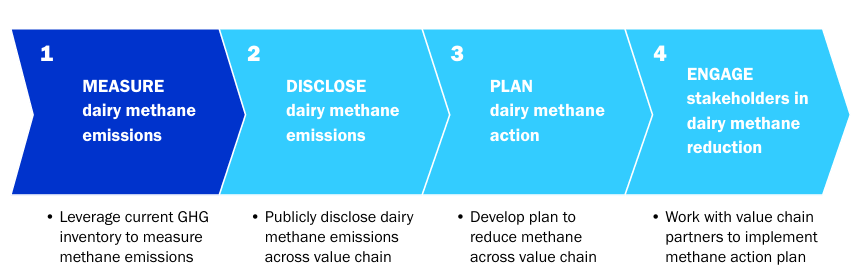
To help companies navigate this four-step guidance to dairy methane mitigation, we recommend starting with the following action steps:
- Measure Dairy Methane Emissions: Companies develop a methane-specific inventory derived from their corporate greenhouse gas (GHG) inventory.
- Disclose Dairy Methane Emissions: Companies determine key methane emission metrics to disclose and align their reporting with best practices in dairy methane disclosure and leading environmental, social, and governance (ESG) frameworks.
- Develop a Dairy Methane Action Plan (DMAP): Companies create and disclose action plans that outline programs and projects to reduce dairy methane emissions in the near term, integrating these initiatives with their broader climate strategy.
- Engage Stakeholders in Dairy Methane Reduction: To implement DMAPs and drive methane reduction across the value chain, companies collaborate with a range of stakeholders, including farmers, suppliers, innovators, and policymakers.
For companies seeking to deepen their understanding of the four-step guidance framework, we recommend the following resources:
Enroll in Our Free Dairy Methane Action E-Learning Course
This course equips dairy companies with essential knowledge and tools to measure, disclose, and act on methane emissions. Through four targeted modules, participants will explore best practices in methane accounting, disclosure, action planning, and stakeholder collaboration—supporting alignment with global climate goals.
EDF's Dairy Methane Masterclass
Ready to learn more? Gain practical insights into methane accounting, disclosure, action planning, and stakeholder engagement.
Access Our Comprehensive DMAA Guides for In-Depth Content and Practical Examples
Recognizing the urgency of the climate crisis and the significant role of the food sector in reducing global methane emissions, all companies in the global dairy supply chain have the opportunity to expedite methane reductions and deliver a larger impact and scale.