Create a Dairy Methane Action Plan
Environmental Defense Fund
Upon creating a methane inventory and disclosing key methane metrics, dairy-sourcing companies should develop a clear plan for addressing methane emission hotspots, known as a Dairy Methane Action Plan (DMAP). A strong DMAP should build on key methane disclosures; outline reduction strategies with specific actions, timelines, and expected outcomes; track progress; and be integrated into the company’s broader sustainability efforts.

Developing DMAPs is essential as the dairy industry works to reduce its global methane emissions and address climate risks. Publishing a DMAP allows companies to prioritize actions, gain internal and external support, and tackle a critical component of climate action. Companies may develop their DMAPs as part of broader climate and nature plans, such as a Climate Transition Action Plan (CTAP), or as standalone roadmaps focused on dairy methane. Either way, CTAPs are not strictly required to develop DMAPs.
DMAPs also showcase industry leadership, emphasizing that methane reduction in the dairy and livestock sectors is vital for long-term resilience and profitability. They promote transparency by meeting the expectations of regulators, investors, and consumers and hold dairy-sourcing companies accountable for progress in supplier engagement, innovation, and advocacy efforts surrounding methane action. Dairy-sourcing companies should review their DMAPs every one to three years and disclose any necessary updates to ensure continued progress.
Components for Designing a DMAP
Dairy-sourcing companies should incorporate four essential components into their DMAPs: (1) methane disclosures and hotspots; (2) strategies for reducing dairy methane emissions; (3) additional considerations, including barriers, systemic challenges, and just transition principles; and (4) a strategy for disclosing progress. Below, we explore these components in detail to assist companies in creating a comprehensive DMAP.
Component 1: Key Disclosures
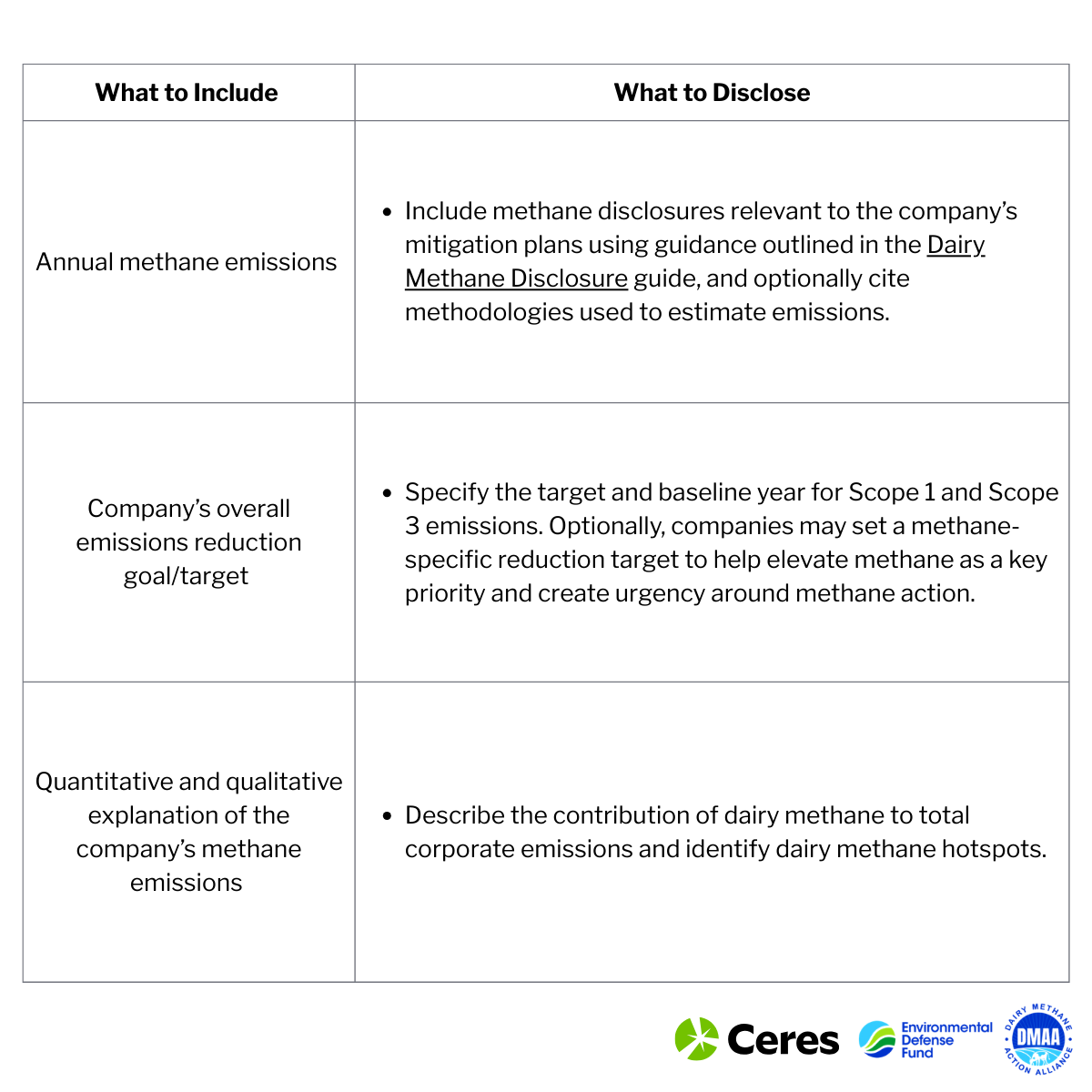
The DMAP’s first section should disclose total annual methane emissions as well as the primary sources of methane emissions—or methane hotspots—in a company’s supply chain, such as enteric emissions and manure management, detailing aspects like geography, business units, and suppliers, as relevant.
More specifically, companies should disclose the following:
Component 2: Strategies to Reduce Dairy Methane Emissions
The second section should focus on communicating the company’s planned methane mitigation actions. When drafting DMAPs, dair-sourcing companies should take a holistic approach, incorporating three primary strategies:
- Farmer and Supplier Engagement Strategy: This component of the plan is arguably one of the most critical, given that methane related to dairy production is largely emitted at the farm level. To establish this strategy, companies must first thoughtfully identify the most appropriate and strategic methane mitigation solutions to implement at the farm level, making sure to factor in specific supply chain and geographic factors. For information on potential solutions, please download the Dairy Methane Mitigation Solutions document, which is also included in the Dairy Methane Action Plan Guide (pages 33-39). Once solutions have been identified, dairy-sourcing companies should outline tactics for engaging farmers and suppliers in solution implementation. Such tactics may include:
- Piloting new solutions on farms before broader implementation.
- Incentivizing producers through compensation mechanisms.
- Offering technical assistance for adoption.
- Partnering with peers or customers to co-invest in projects.
- De-risking transitions with yield-gap guarantees.
- Implementing procurement policies with volume guarantees.
- Identifying government cost-sharing programs.
- Innovation Strategy: Companies can play a critical role in accelerating innovation around emerging and novel methane-mitigating solutions. As such, DMAPs should outline how companies will support the development and/or advancement of next-generation methane-abating technologies. This may include the following tactics (When evaluating innovative methane mitigation opportunities, it is also important to assess potential social and environmental trade-offs):
- Participating in public-private partnerships funding methane research.
- Investing in methane-abating technologies through venture capital.
- Supporting commercial trials to advance research.
- Supporting pilot testing and development of methane monitoring infrastructure.
- Considering the incorporation of plant-based and alternative protein products as part of a diversified portfolio to reduce dairy methane footprint.
- Public Policy Advocacy Strategy: The regulatory environment shapes the feasibility of methane solution implementation, and companies can play a key role in influencing legislation that accelerates progress in this area. The public policy advocacy section of the DMAP should specify how dairy-sourcing companies will support public policies that promote methane reduction actions. Specific actions may include:
- Supporting policies that advance methane monitoring, reporting, and verification (MMRV).
- Advocating for financial and technical support for methane solutions.
- Promoting increased public R&D funding for early-stage innovation.
- Supporting regulatory reforms for feed additives and methane solutions.
- Engaging industry groups for lobbying aligned with methane reduction goals.
- Supporting policy incentives for farmer adoption and startup scaling of methane solutions.
Component 3: Additional Considerations for Dairy Methane Action Plans
The third section of the DMAP should emphasize all additional considerations necessary for comprehensive dairy methane action. Companies may need to update this section more frequently to maintain effectiveness. Key considerations to highlight include:
- Barriers preventing suppliers from adopting mitigation solutions and actions to address them.
- Systemic Challenges limiting near-term methane mitigation (e.g., early-stage technology) and plans for future monitoring.
- Just Transition Considerations, such as actions to support farmers, workers, and vulnerable communities during the transition, including addressing farm access to technologies and affordability of lower methane dairy products.
- Stakeholder Engagement, such as plans to consult and implement feedback from workers, suppliers, and impacted communities.
- Synergies with other sustainability efforts like water, biodiversity, and community support.
Additionally, companies may detail strategies to reduce non-dairy methane emissions (e.g., beef, rice) and outline long-term methane reduction goals extending beyond five-10 years.
Component 4: Progress Disclosure
The last section of the DMAP should focus on reporting annual progress on absolute changes in methane emissions and updates on implementing key strategies. Companies may also optionally report methane emission changes on an intensity basis to indicate changes per unit of sourced or produced dairy.
The DMAP progress disclosure should also provide a qualitative summary of methane emissions changes and progress towards goals, along with updates on strategy implementation, milestones, and KPIs related to supply chain engagement, innovation, and policy advocacy.
Next Steps and Beyond
Finally, a comprehensive DMAP should communicate the actions a company will take in the near term (five-10 years) and perhaps even outline a long-term strategy extending to 2050 and beyond. This long-term plan could involve aligning current investments with the company’s vision for future operational resilience and value creation. Additionally, it is crucial that the DMAP be integrated into the company’s broader climate and nature strategies to maximize impact and ensure alignment across all sustainability efforts.
Publicly disclosing a methane reduction plan establishes a foundation for stakeholder engagement in implementing these efforts. After publishing a DMAP, companies should collaborate with stakeholders throughout their methane reduction journey. EDF’s Dairy Stakeholder Engagement Guide offers best practices for collaborating with stakeholders across areas of methane action—from farmer engagement to innovation to policy advocacy.
EDF's Dairy Methane Masterclass
Ready to learn more? Gain practical insights into methane accounting, disclosure, action planning, and stakeholder engagement.