Decarbonize Maritime Shipping
Environmental Defense Fund
This action guidance provides maritime shipping providers and users with a roadmap to reduce emissions, enhance transparency and accelerate the adoption of cleaner technologies and fuels. By taking proactive steps now, industry stakeholders can secure long-term competitiveness, mitigate regulatory and reputational risks and contribute to a more sustainable future for maritime transport and the communities it serves.
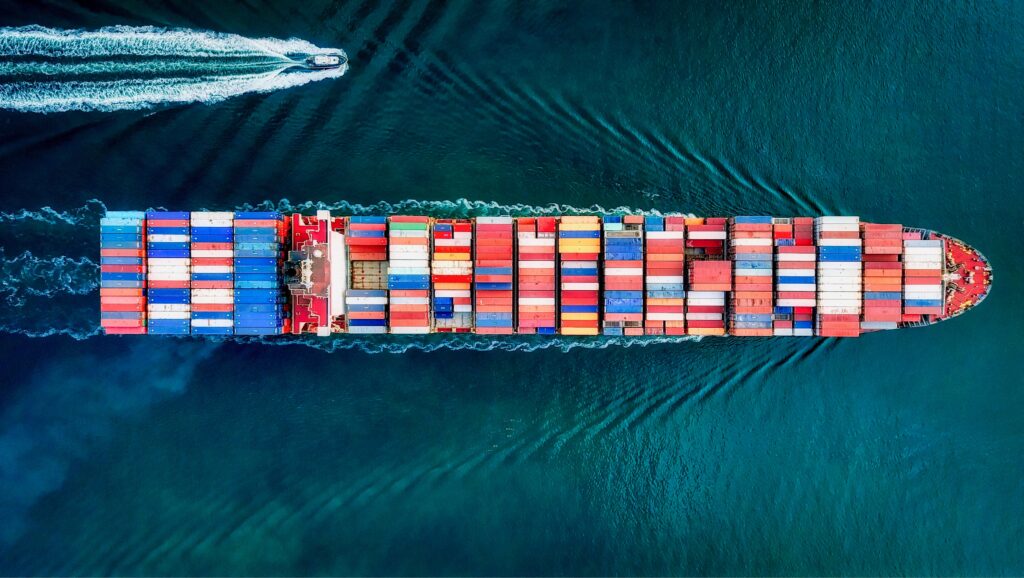
Maritime shipping accounts for about 90% of globally traded goods1 and nearly 3% of global greenhouse gas (GHG) emissions.2 If the shipping industry were a country, it would be among the world’s top carbon-emitting nations.3 Under a business-as-usual baseline, which is defined as no new shipping-specific energy efficiency or carbon-intensity regulations, the emissions of shipping could increase by up to 40% from 2018 levels by 2050.4
In addition to its climate impacts, the sector also contributes to air pollution that harms the health of people living in port communities and coastal areas.
The International Maritime Organization (IMO) is advancing a set of global policies to decarbonize shipping by 2050. This includes the first-ever carbon price for shipping and a fund for disbursing the revenues. The proposed rules also include a global fuel standard aimed at reducing the GHG intensity of marine fuels and a measure to ensure ships are more energy efficient. Final adoption is expected by the end of 2026 with implementation beginning in 2028.
Leading ship owners across key industry segments have already set net zero targets and committed to emissions reduction goals. Taking action now to align with the emerging IMO framework positions your company for long-term success, reducing regulatory, financial and reputational risk while strengthening market competitiveness and accelerating access to low-carbon technologies.
Alternative fuels are not inherently sustainable
Their environmental and social benefits depend on how they are produced, handled and used. Therefore, it’s important for companies to build an internal understanding of the climate, environmental and public health impacts of alternative fuel pathways through a full lifecycle lens. Due to the variation in production pathways and value chain configurations, the same fuel can have a large range of emissions, environmental impacts and health outcomes. Assessments of alternative fuels should go beyond traditional LCAs to include transparent accounting of direct and indirect GHGs over short‑ and long‑term time scales; air quality and ecosystem impacts; “cradle‑to‑grave” emissions from infrastructure, production, energy sources, materials (including feedstock and products) transport, unintended and operational emissions, storage, and end use; opportunity costs of individual feedstocks and energy sources; and comparisons of viable alternatives to determine the most sustainable options. The goal of the assessments is to identify solutions with the greatest benefits and lower harms to the climate, environment and communities. For further guidance, see EDF’s scientific perspective paper “Ensuring the climate and environmental integrity of alternative fuels” which provides a rigorous, science-based framework for evaluating alternative fuel pathways across their value chains and best practices to guide responsible deployment.
Key Actions for Maritime Shipping Providers
In the near term, ship owners and operators should adopt solutions that reduce fuel usage. Improving energy intensity, which means reducing the fuel required to transport one unit of cargo over a given distance through operational and technical efficiency measures, is the fastest way to cut emissions now while keeping ships compliant with energy efficiency regulatory requirements. Improving energy intensity also reduces fuel consumption, which directly lowers operating expenses, and prepares shipping providers for the future as emerging zero and near zero-emission fuels and technologies (ZNZs) are expected to be more expensive and have lower volumetric energy density than conventional fuels. Scaling up the integration of ZNZs over time will also be essential to drive the longer-term transition.
Shipping providers can begin by taking the following steps, selecting those that are most relevant, and where possible, combining multiple strategies to maximize impact:
- Commit to reach zero-emission shipping by 2050: Set a target to eliminate emissions of CO2 and other GHGs based on a full fuel lifecycle accounting by 2050 or sooner.
- Adopt interim emissions reduction targets consistent with long-term goals: Credible decarbonization plans include immediate reductions in carbon intensity, instead of postponing significant emissions cuts to later years. Interim targets should address:
- Carbon intensity targets: Set and disclose targets for declining GHG intensity (in g CO2e/dwt/nm or a similar metric) in the near- and medium-term, i.e., by 2030 and by 2040, and report annually on investments and progress towards those goals. Upgrade your fleets so that all vessels are on track to achieve an “A” or “B” efficiency rating in the IMO Carbon Intensity Indicator system that took effect in 2023.
- Fuel strategy. Develop and disclose long-term and transitional fuel strategies, addressing factors such as demand projections and infrastructure needs. These strategies should consider climate and environmental impacts throughout the full lifecycle of marine fuels. Liquefied natural gas (LNG) lifecycle emissions, which are driven largely by upstream and midstream methane leakage, equal or exceed those of coal, making it incompatible with zero or near-zero emissions pathways. Shipping providers that have adopted LNG or biofuel blending as near-term measures should clearly articulate how these choices fit into a time-bound transition plan to fully shift to zero and near-zero emissions fuels and technologies consistent with your targets.
- Ship purchase and upgrade strategy. Adopt and disclose fleet transition plans encompassing both new-build and vessel retrofits that establish a path to full fleet decarbonization, including short-, medium- and long-term goals and fuel strategies.
- Energy efficiency measures. Increasing vessels’ fuel efficiency is a readily available, cost-effective means to reduce fuel consumption and associated emissions. The options depend on vessel type and operational profile and include technical measures such as hull and propeller optimization; alternative propulsion systems such as wind-assist; and operational efficiency measures such as route optimization and speed reductions. Shipping providers should disclose fleet efficiency strategies in transition plans.
- Provide cargo-level emissions data. Disclose emissions per ton (or TEU) of cargo transported per distance carried, and work toward providing customers with emissions data per cargo unit – including lifecycle CO2 and non-CO2 emissions – to support supply chain emissions management.
- Disclose beyond standard metrics. The Sustainable Accounting Standards Board (SASB)’s Marine Transportation Standard, which is included in the International Sustainability Standards Board (ISSB) Climate-Related Disclosures, recommends several helpful metrics for maritime shipping providers, as do the IMO Data Collection System and EU regulations on monitoring, reporting and verification and corporate transparency (especially the Corporate Sustainability Reporting Directive or CSRD). However, shipping providers should go beyond these metrics to provide further disclosures including:
- GHG emissions: Disclose Scope 1, 2 and 3 emissions and identify which are related to shipping.
- Carbon intensity: This should be expressed at the fleet level in gCO2/dwt/nm or a similar metric and complemented at the vessel level with the IMO carbon intensity indicator letter grade
- Fuel mix: Disclose total energy consumed along with the percentage share of each fuel type (e.g., very low sulfur fuel oil (VLSFO), heavy fuel oil (HFO), marine gas oil (MGO), liquefied natural gas (LNG) and zero and near-zero emission fuels and technologies). Disclosures should be presented on a full lifecycle basis, including the associated GHG emissions of each fuel type. Providers should also indicate any use of electricity at berth and the proportion of total energy it represents.
- Climate strategy and progress: Disclose emissions targets and transition plans, as well as an analysis of performance against those targets. This could include, for example, fleet transition strategy, zero-carbon capex plans or the share of cargo-miles shipped using zero and near-zero carbon fuels and technologies.
- Support the development of “green” ports and corridors. Participate and co-invest in pilot programs and early learning opportunities centered on port electrification and low-carbon shipping corridors. In addition to launching new projects, prioritize support for established green corridor initiatives such as those led by the Global Maritime Forum (GMF) and C40 Cities.
- Advocate for clean shipping policies at international, regional, national and local levels. Strong policy support for clean shipping can reduce costs associated with the transition while accelerating decarbonization. Shipping providers should directly engage in the development and support of ambitious policies to align with the Paris Agreement. Notably, shipping providers should advocate for the adoption of the IMO Net Zero Framework.
Key Actions for Maritime Shipping Users
Maritime shipping users, including cargo owners and charterers, play an important role in the global supply chain and have a significant influence over shipping industry practices and sustainability outcomes. By prioritizing the use of low-emissions vessels and working with providers committed to decarbonization, your company can help accelerate the transition to cleaner shipping and reduce the climate impact of your operations.
Here are the essential steps shipping users can take:
- Prioritize climate performance in shipping procurement. Seek out providers with zero-emission targets, explicit transition plans, ongoing or committed emissions reductions, and other indicators of leadership in the energy transition. This could include committing to ship a minimum share of freight with providers that have explicit decarbonization targets and engaging directly with providers to understand their transition plans and encourage ambition. Consider joining the Zero Emission Maritime Buyers Alliance (ZEMBA), which aims to aggregate demand for zero-emission shipping to accelerate the availability and adoption of low-carbon supply chain services.
- Place cargo on the cleanest, most fuel-efficient vessels possible. Preferencing ships sailing on alternative fuels or with an IMO rating of “A” or “B” can drive near-term emissions reductions and support corporate Scope 3 goals.
- Signal a willingness to pay more for zero-carbon shipping services. In the initial years of the transition, zero-carbon fuels will be more expensive than traditional fossil fuels. Shipping users should communicate their willingness to pay a premium for their use.
- Support the development of “green” ports and corridors and commit to using them when they become available. Demand from shipping customers is important to justify early investments in alternative-fuel ships and infrastructure. By participating in such green corridors, shipping users can accelerate their deployment at scale.
- Advocate for clean shipping policies at international, regional, national and local levels. By engaging in policy advocacy, shipping users can help shape regulations and incentives that promote zero-emission shipping, lower the price gap between scalable zero-carbon fuels and fossil fuels, and drive the adoption of the IMO Net Zero Framework. This collective action amplifies demand for clean shipping and helps create enabling conditions for the entire sector to transition toward sustainability.
Implement Energy Efficiency and Demand Reduction Technologies
In the near term, improving the energy efficiency of shipping through technical and operational measures offers a clear path to reducing overall emissions while supporting the long-term transition to zero-emission fuels. Technologies like wind-assisted propulsion and air lubrication, combined with operational strategies such as speed optimization, can significantly reduce fuel use and emissions. As the sector shifts toward zero-emission fuels like green ammonia and bio-methanol, alongside the necessary vessels and infrastructure, reducing energy use through higher efficiency will be critical in offsetting the higher costs of alternative fuels.
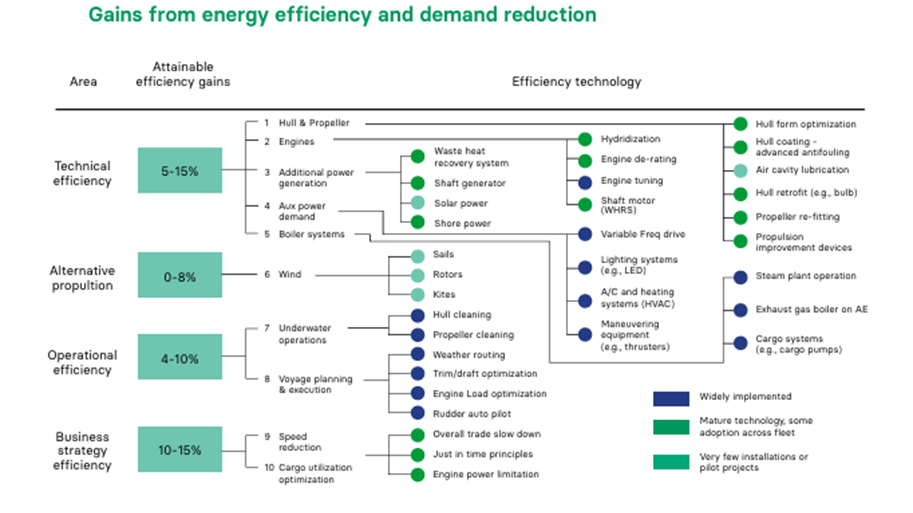
Note: This figure came from EDF and MMM Center for Zero Carbon Shipping’s Maritime Makeover Report. Source: MMM Center for Zero Carbon Shipping, Industry Transition Strategy (2011).
Invest In and Use Cleaner Alternative Fuels
While costs are expected to decline as production scales up, many alternative fuels will remain more expensive than fossil fuels for the foreseeable future. Each alternative fuel has its own advantages but also presents technical, commercial, and regulatory challenges. They also vary in performance, cost, operational capabilities, and scalability. The shipping industry will likely need a mix of fuel solutions to meet the diverse needs of shipping operations. To enable the transition, ship builders, ship owners and operators, ports, fuel providers, shipping customers, investors and financiers must work together to address key barriers and align investments with ship deployment timelines and infrastructure needs. It is also important to support efforts to improve our understanding of future fuels and their broader environmental impacts, ensuring that fuel solutions deliver the greatest possible climate benefits while safeguarding the health of our communities, oceans, rivers or other waterways.