Create a Dairy Methane Inventory
Environmental Defense Fund
Visibility to methane emissions via corporate GHG accounting can help food and dairy companies identify and target their most impactful GHG reduction opportunities. Separating methane emissions from other GHG emissions by activity (e.g., enteric fermentation, manure management, feed) is a critical first step to support this work.
Reducing methane can significantly impact global warming over the next few years, so the time to act on methane is now. Since methane comprises approximately 60% of dairy emissions1, the dairy industry has a significant opportunity to reduce its methane impact and slow global climate change in the near term. To begin reducing methane, dairy companies must understand how to measure and publicly report their methane emissions.
This section first outlines how dairy-sourcing companies can set up their corporate GHG inventories to allow for methane disaggregation, then details the methodology for disaggregation.
Impact of Dairy Methane
Due to its potency and short atmospheric lifespan, methane from dairy cattle is a critical focus for global emissions-reduction efforts. Livestock agriculture contributes nearly 15% of global anthropogenic emissions, with cattle being the primary source of agricultural methane, responsible for around 32% of these emissions. Methane from enteric fermentation and manure management collectively represent over half of livestock emissions, with dairy cattle alone contributing about 10% of global methane emissions.
By calculating methane emissions, dairy-sourcing companies can identify hotspots and prioritize where to focus GHG reduction strategies. However, many accounting methodologies are not yet set up to explicitly separate methane from other emissions. To start this journey, dairy-sourcing companies should focus on setting up their existing GHG inventories to enable methane disaggregation and then select the appropriate methodology to break out methane based on the data sources used.
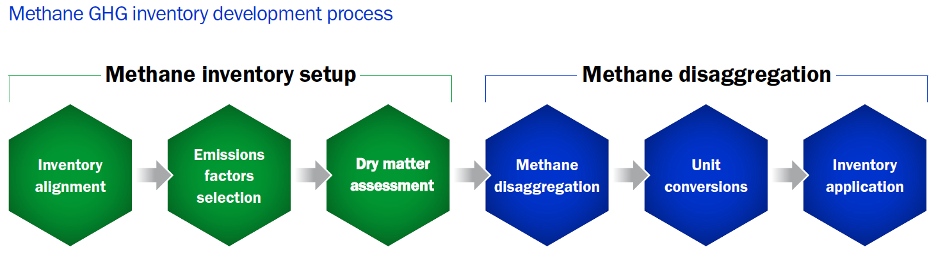
Figure 1
Process for Developing a Methane Inventory
Initial Steps: Align your company’s existing GHG inventory with the GHG Protocol, select appropriate emission factors (EFs), and assess the quantity of milk dry matter in dairy products to estimate the emissions of different dairy products.
- Inventory Alignment: Before disaggregating methane, it is important that current corporate inventories comply with best practices like the GHG Protocol Corporate Standard and Scope 3 Standard and select appropriate boundaries for Scope 1, 2, and 3 emissions based on financial or operational control. A cradle-to-farm gate boundary is commonly used to account for agricultural methane since it facilitates tracking on-farm processes and benchmarking progress at the farm level.
- EF Selection: Choose EFs that most accurately reflect the carbon impact of dairy activities throughout your value chain. High-quality EFs should disaggregate emissions by source (e.g., enteric fermentation, manure management) and represent the geographies, technologies, farm sizes, and production systems applicable to your company’s dairy sourcing. See Figure 2 for a ranking of EF types based on ability to disaggregate methane and customize to company sourcing practices. While data quality is important for accurate accounting and action planning, companies must balance seeking high-quality data with efficiency, practicality, and cost.
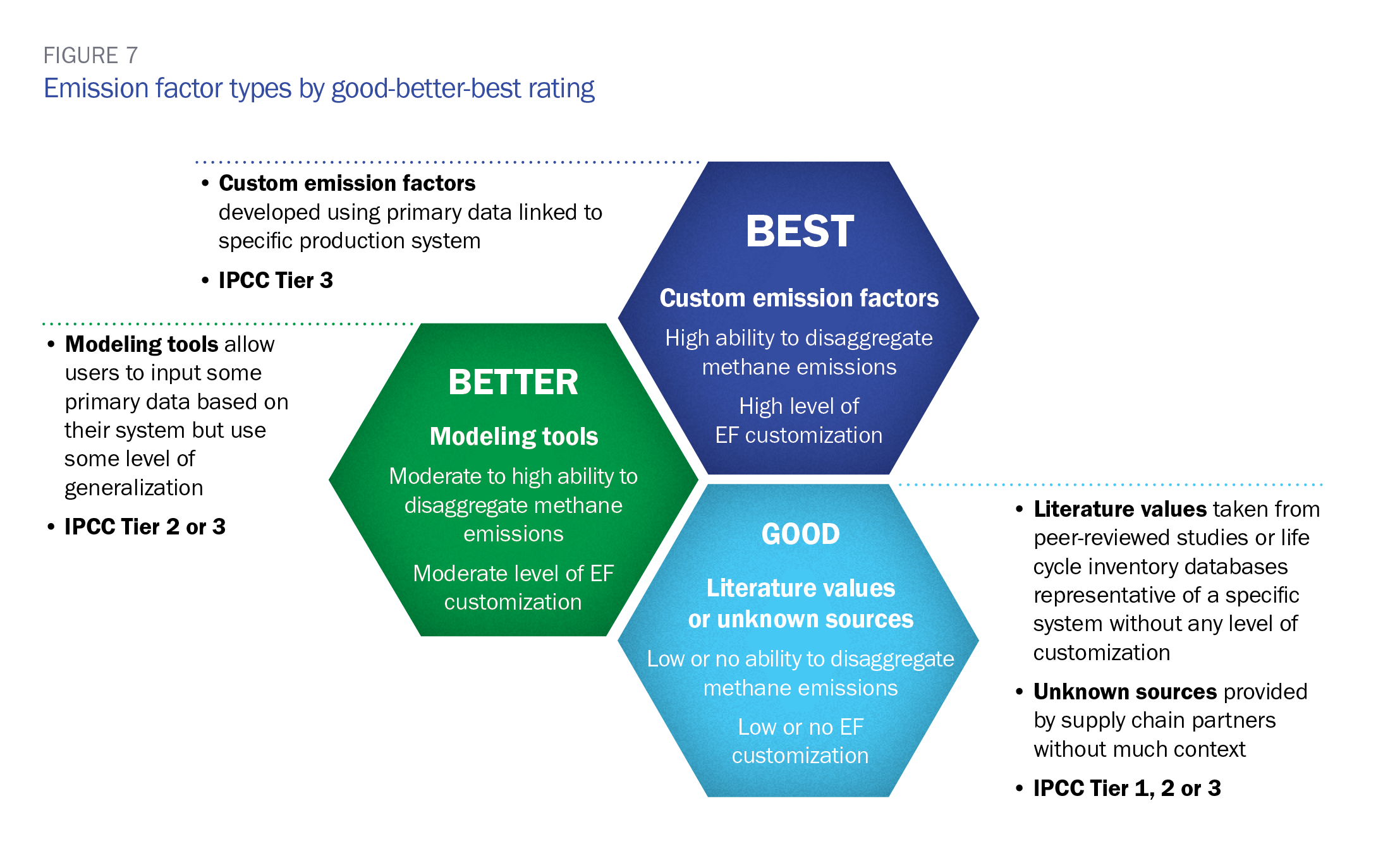
Figure 2
- Dry Matter Assessment: The next step is to assess the quantity of milk dry matter in dairy products and relate it to standardized units of milk to estimate the emissions of different dairy products. This enables you to disaggregate emissions from dairy products by GHG in the next stage.
Process for Disaggregating Methane
Complex supply chains may require multiple EFs for different regions or production systems, using varied data sources and methods.
Different EF data sources require different methodologies to disaggregate methane. Some EFs provide methane already broken out, whereas others require assumptions to be applied because they lack more granular information. Selecting high-quality data early on in GHG accounting can help minimize the effort of disaggregating methane emissions from EFs.
For step-by-step walkthroughs of methane disaggregation for each EF source, please reference the Dairy Methane Accounting Guide or EDF’s Dairy Methane Masterclass e-learning training.
Inventory Application and Hotspot Identification
After isolating methane emissions per unit of standardized milk, this methane-specific EF can be applied to all purchased dairy products to obtain total methane emissions (in kg CH4) from milk- and dairy-containing products.
Example
Methane-Specific Emission Factor
For example, if the calculated EF for a company’s conventional milk supply is 0.019 kg CH4/kg FPCM and the company purchases 12,500,000 kg of conventional milk, you would multiply those values to get 13,635 kg total CH4 emissions for the conventional milk supply.
Identifying methane hotspots—areas with disproportionately high GHG emissions—is essential for prioritizing mitigation strategies. Analyzing data by region, product type, emission source, and supplier helps target high-emission areas. Prioritizing regions or suppliers over which the company has significant control ensures the most effective reduction strategies, focusing on impactful areas within the supply chain.
Upon completing their inventories, companies can disclose their dairy methane emissions to drive transparency and accountability around corporate dairy methane. Companies can then use the insights gleaned from the inventory and hotspot identification to develop a dairy methane action plan.
The Dairy Methane Accounting Guide offers a detailed overview of dairy methane accounting. Companies can also choose to enroll in the EDF’s Dairy Methane Masterclass, which provides a deeper dive into the topic, including a clear example of a company’s journey in developing a methane inventory.
EDF's Dairy Methane Masterclass
Ready to learn more? Gain practical insights into methane accounting, disclosure, action planning, and stakeholder engagement.